How to Cork a Wine Bottle Properly and Keep Your Wine Fresh
Post Disclaimer
*We may earn a commission for purchases made using our links. Please see our disclosure to learn more.
Opening a bottle of wine is easy, but getting the cork back in can be surprisingly difficult. Whether you have leftover red wine from dinner, an unfinished bottle of white wine, or homemade wine ready for bottling, knowing how to cork a wine bottle properly helps protect its flavor and freshness.
Once a wine bottle is opened, oxygen begins interacting with the wine. Some exposure can improve its aroma and taste, but prolonged exposure can cause oxidation, leaving the wine flat, dull, or unpleasantly sour.
Fortunately, you do not need professional equipment to reseal an opened bottle. In many cases, the original cork will work. Wine stoppers, vacuum sealers, and specialized corking tools offer alternatives depending on how long you plan to store the wine.
This guide explains how to put a cork back into a wine bottle, what to do when the cork no longer fits, how to seal a bottle without its original cork, and which tools can make the process easier.
“So I honestly believe if you want to buy some time for the wine, the best way is to lower the temperature.”
— Lauren Harris, wine director, quoted by Consumer Reports
Key Takeaways
- To recork an opened wine bottle, check that the original cork is clean and undamaged, then gently twist its narrower end back into the bottle.
- A reusable wine stopper is often easier to use and can provide a more reliable seal than the original cork.
- Vacuum wine savers help reduce air exposure, while sparkling wines require pressure-resistant Champagne stoppers.
- Homemade wine requires fresh, correctly sized corks and a suitable corking tool.
- Store opened wine in the refrigerator, including red wine, to slow oxidation and help preserve its flavor.
Four Useful Products for Corking and Resealing Wine Bottles
The right wine accessory depends on whether you are saving an opened bottle, preserving sparkling wine, or bottling homemade wine.
These four products address different corking and preservation needs.
1. Vacu Vin Original Wine Saver Pump with Vacuum Stoppers


Vacu Vin Wine Saver Vacuum Stoppers, crafted from high-quality food-grade rubber, aim to preserve your wine's flavor for up to a week. Designed to partner seamlessly with the Vacu Vin Wine Saver Pump, these stoppers offer a universal fit for all bottles, ensuring an airtight vacuum upon insertion into an opened wine bottle neck. Their durability withstands dishwashing for convenient cleaning, promising years of reliable use. Even without the Vacu Vin Wine Saver Pump, these stoppers function as traditional seals, effectively maintaining wine freshness for an extended duration. With over 30 years of industry leadership, Vacu Vin is a trusted brand known for innovative barware accessories and kitchen gadgets.
- Preserves Flavor: Effectively keeps wine fresh for up to a week, maintaining its taste and aroma.
- Universal Fit: Designed to fit all types of bottles, ensuring an airtight seal for extended preservation.
- Dishwasher Safe: Crafted from durable, food-grade rubber that's dishwasher safe for easy maintenance.
- Dependent on Specific Pump: Optimal functionality is achieved when used with the Vacu Vin Wine Saver Pump; might not perform the same without it.
- Material Dependency: Made of rubber, which may wear over time and with prolonged use.
- Compatibility Limitation: While suitable for most bottles, compatibility might vary with unconventional bottle shapes or sizes.
Best for preserving opened still wine
The Vacu Vin Original Wine Saver is a reusable wine preservation system that includes a manual vacuum pump and compatible bottle stoppers.
After inserting a stopper, you operate the pump to remove some of the remaining air. This helps limit oxygen exposure and can slow the deterioration of opened wine.
Its straightforward design makes it practical for anyone who regularly enjoys wine over several days rather than finishing a bottle in one sitting.
Why consider it
- Easy-to-use manual pump
- Reusable wine stoppers
- No batteries required
- Suitable for most standard still-wine bottles
Keep in mind: Vacuum preservation does not guarantee that wine will remain fresh for a specific number of days. Refrigeration is still recommended, and this system should not be used for sparkling wine.
2. OXO SteeL Leakproof Expanding Wine Stoppers


The OXO Steel Double Lever Waiter's Corkscrew combines durability, comfort, and convenience for effortless wine opening. Crafted from stainless steel with a soft, non-slip handle, this corkscrew features a double-lever mechanism that provides extra leverage for smooth cork removal in two simple steps. Its non-stick spiral glides easily into corks, while the integrated bottle opener and fold-out foil cutter add everyday versatility. With its sleek silver and black design, it's a practical accessory for wine enthusiasts, home entertaining, and dinner parties.
- Easy Cork Removal: Double-lever mechanism provides smooth, effortless cork removal.
- Comfortable Grip: Soft, non-slip handle offers secure and comfortable handling.
- Versatile Design: Includes a built-in bottle opener and fold-out foil cutter.
- Manual Operation: Requires some physical effort to open bottles.
- Learning Curve: Double-lever mechanism may take practice for beginners.
- No Wine Preservation: Does not include a stopper for storing opened wine.
Best for everyday resealing
The OXO SteeL Leakproof Expanding Wine Stoppers provide a convenient alternative when the original cork no longer fits.
Their expanding silicone seals are designed to fit securely into standard wine bottle openings.
Pressing the top activates the expanding mechanism, helping prevent leaks while limiting additional air exposure.
The low-profile design also makes these stoppers useful when refrigerator space is limited.
Why consider them
- Simple push-to-seal design
- Reusable expanding silicone seals
- Compact for refrigerator storage
- Convenient for everyday use
Keep in mind: These stoppers seal the opening but do not remove oxygen already inside the bottle.
3. KLOVEO WAF Champagne Stopper


The KLOVEO Champagne Stopper features a patented WAF self-tightening seal designed to preserve the bubbles and freshness of sparkling wine for up to 3–5 days. Made in Italy, it uses internal bottle pressure to create a secure seal without a pump. Its stainless steel locking clip provides easy, reliable closure, while the BPA-free construction makes it suitable for everyday use. Compatible with standard 750ml Champagne, Prosecco, and Cava bottles, this reusable stopper helps keep sparkling wine fresh between servings.
- Patented Seal: Helps preserve carbonation for 3–5 days.
- Easy Locking: Secure stainless steel clip requires no pump.
- Italian Quality: Durable, reusable, BPA-free design.
- Bottle Compatibility: May not fit nonstandard bottle necks.
- Limited Freshness: Cannot preserve bubbles indefinitely.
- Higher Price: Costs more than basic wine stoppers.
Best for Champagne and sparkling wine
The KLOVEO WAF Champagne Stopper is designed specifically for sparkling wines, including Champagne, Prosecco, and Cava.
Unlike standard wine stoppers, its pressure-resistant sealing mechanism helps retain carbonation after the bottle has been opened.
A locking clip secures the stopper to compatible bottle necks, reducing the risk of it being pushed off by internal pressure.
Why consider it
- Designed for pressurized sparkling wine bottles
- Secure locking mechanism
- Reusable construction
- Helps reduce carbonation loss
Keep in mind: Always confirm bottle compatibility and follow the manufacturer’s instructions. Open a sealed sparkling bottle carefully because pressure may remain inside.
4. FastRack Double Lever Corker with Corks


The FastRack Double Lever Corker is a durable, easy-to-use tool designed for sealing homemade wine bottles. Made in Portugal, this 14-inch corker features a dual-lever mechanism that provides better control and reduces the effort needed to insert corks. It accommodates #7, #8, and #9 corks and includes 20 pieces of #8 agglomerated wine corks. Its sturdy construction and ergonomic design make it a practical choice for beginner and experienced home winemakers looking for consistent, secure bottle closures.
- Dual-Lever Design: Makes cork insertion easier and more controlled.
- Cork Compatibility: Supports #7, #8, and #9 cork sizes.
- Complete Kit: Includes 20 wine corks for immediate use.
- Manual Operation: Requires physical effort when corking bottles.
- Small-Batch Use: Less efficient than floor corkers for large batches.
- Limited Cork Supply: Includes only 20 corks.
Best for bottling homemade wine
The FastRack Double Lever Corker is designed for inserting new corks into wine bottles.
Its dual-lever mechanism compresses and pushes a cork into the bottle neck, making it useful for home winemakers preparing small batches.
This type of tool is different from a wine stopper. It is intended for bottling wine rather than temporarily resealing a partially consumed bottle.
Why consider it
- Double-lever cork insertion mechanism
- Designed for home winemaking
- Includes starter corks
- Practical for occasional small-batch bottling
Keep in mind: Verify that the selected cork size matches your bottles and corker. For larger batches, a floor corker may be easier to operate.
How to Cork a Wine Bottle After Opening
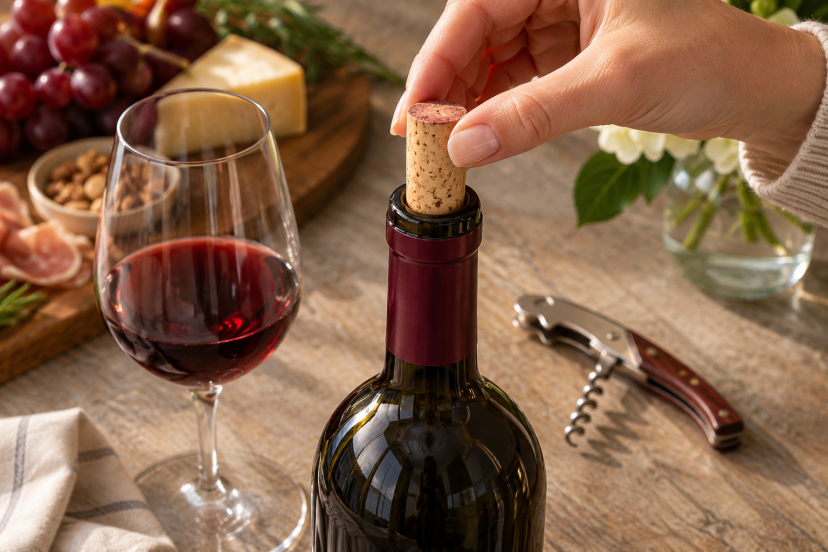
If you have removed the cork from a bottle of wine and want to save the remaining contents, you can often reuse the original cork.
However, the cork may have expanded after removal, making it difficult to fit back into the narrow bottle opening.
Follow these steps to reseal the bottle without damaging the cork or glass.
Step 1. Inspect the Original Cork
Start by examining the cork for damage. Look for cracks, crumbling edges, mold, or pieces that have broken away.
A healthy cork should feel reasonably firm and flexible. If it is brittle, severely damaged, or visibly dirty, replace it with a clean wine stopper rather than attempting to reuse it.
Step 2. Identify the Narrower End
Most natural corks are compressed when initially inserted into wine bottles. Once removed, they begin recovering their original shape.
The end that has been in contact with the wine may also be slightly swollen.
Compare both ends and identify which one fits more easily into the bottle opening. Often, this is the end that originally faced outward.
Before reinserting it, make sure that end is clean and free from dust, debris, or other contamination.
Step 3. Position the Cork Over the Bottle
Place the bottle upright on a stable, flat surface.
Hold the cork directly above the opening, positioning the narrower end against the bottle’s neck.
Keep the cork straight rather than attempting to insert it at an extreme angle. This helps prevent uneven pressure against the glass.
Step 4. Twist and Apply Gentle Pressure
Hold the bottle securely with one hand while gently twisting the cork with the other.
Apply steady downward pressure as you rotate it. The cork should gradually enter the neck without requiring excessive force.
You do not need to push the cork completely back to its original position. Inserting it far enough to create a reasonably secure temporary seal is usually sufficient.
If it refuses to fit, stop rather than forcing it.
Step 5. Refrigerate the Bottle
Once the bottle is closed, place it upright in the refrigerator.
Refrigeration slows oxidation and helps preserve the remaining wine’s flavors and aromas.
This applies to red wine as well as white and rosé. Simply allow refrigerated red wine to warm slightly before serving if you prefer it at a higher temperature.
Why Won’t the Cork Go Back Into the Wine Bottle?
A wine cork is naturally wider than the opening of the bottle it seals. During commercial bottling, specialized machinery compresses it before insertion.
After the cork is removed, its compressed structure begins expanding again.
Natural cork can also change shape after prolonged contact with wine, while synthetic corks may recover their original dimensions quickly.
These changes explain why a cork that was easy to remove can be difficult to reinsert.
If gentle twisting does not work, use a reusable stopper. Avoid shaving the cork with a knife, hammering it into place, or applying enough pressure to risk breaking the glass.
How to Cork a Wine Bottle Without the Original Cork
Losing or damaging a wine cork does not mean you have to finish the bottle immediately.
Several alternatives can temporarily seal an opened wine bottle.
Use a Reusable Wine Stopper
Reusable wine stoppers are among the simplest alternatives to traditional corks.
Most feature silicone, rubber, or another flexible material that forms a seal against the inside of the bottle’s neck.
Insert the stopper according to its instructions, checking that it fits securely.
Some expanding designs create a tighter seal when their tops are pressed or twisted.
Use a Vacuum Wine Saver
A vacuum wine saver uses a specialized stopper and a hand-operated or electric pump.
After inserting the stopper, the pump removes some of the air from the bottle, reducing the oxygen available to interact with the remaining wine.
Vacuum systems can help extend the freshness of still wine, although they cannot reverse oxidation that has already occurred.
They are not appropriate for Champagne or other sparkling wines because reducing the pressure can accelerate the loss of carbonation.
Transfer Wine Into a Smaller Bottle
Another effective approach is transferring leftover wine into a smaller, clean, food-safe bottle with a tight-fitting closure.
This reduces the amount of air space above the remaining wine, particularly when the smaller bottle is nearly full.
Choose a container suitable for wine storage, close it securely, and refrigerate it.
Avoid repeatedly transferring the wine between containers, as unnecessary pouring introduces more oxygen.
Use Plastic Wrap as a Temporary Cover
If you have no suitable stopper available, plastic wrap secured with a rubber band can serve as a short-term cover.
Stretch clean, food-safe plastic wrap over the bottle opening and secure it firmly.
This is only a temporary solution. It does not provide the dependable seal of a proper wine stopper and should not be used for transporting or laying down the bottle.
Replace it with a suitable closure as soon as possible.
How to Cork Homemade Wine Bottles
Corking homemade wine requires a different process from resealing wine that has already been opened.
The goal is to create a dependable closure that protects the wine during storage.
Step 1. Make Sure the Wine Is Ready
Only bottle homemade wine once fermentation is complete and the wine has been properly stabilized.
Bottling before fermentation has finished can create dangerous pressure inside the bottle.
The wine should also be clear and appropriately prepared for storage.
Step 2. Clean and Sanitize the Equipment
Wash the bottles and remove any residue before sanitizing them with a product approved for winemaking.
Clean and sanitize the equipment that will contact the wine, including filling tubes and siphons.
Prepare corks according to the cork supplier’s instructions. Some are supplied ready for insertion, while others require specific handling.
Do not assume every type of cork should be boiled or soaked.
Step 3. Select the Correct Cork Size
Most standard still-wine bottles use either a #8 or #9 cork.
A #9 cork is commonly used with standard wine bottles and suitable compression corkers, while a #8 cork may be easier to insert with certain handheld models.
Compatibility depends on the bottle neck, cork material, and corking equipment.
Step 4. Fill the Wine Bottle
Use a sanitized siphon or bottle filler to transfer the wine.
Leave the appropriate headspace between the wine and the bottom of the inserted cork.
Excessive headspace can increase oxygen exposure, while overfilling can create pressure and leakage problems.
Follow the instructions for your bottles, closures, and winemaking kit rather than relying on a single fill measurement for every bottle.
Step 5. Insert the Cork Using a Corker
Place the bottle securely in the corking device.
Position a new cork in the corker’s chamber and operate the mechanism according to the manufacturer’s instructions.
The corker compresses the cork and guides it into the bottle neck.
A properly inserted cork should generally sit approximately flush with the bottle opening.
Step 6. Allow the Cork to Settle
Keep the freshly corked bottles upright for the period recommended by your cork supplier or winemaking instructions.
This allows the compressed cork to recover and form a seal against the glass.
According to North Dakota State University Extension, home winemakers should use new, correctly sized corks and allow newly corked bottles to stand upright for several days before storing them on their sides.
Once the corks have settled, store the bottles according to the needs of the wine and the closure used.
Choosing the Right Cork for a Wine Bottle
Not all wine corks are interchangeable. The material, diameter, and intended storage period can influence which closure is most suitable.
| Cork type | Characteristics | Best use |
|---|---|---|
| Natural cork | Flexible, traditional material | Still wines intended for suitable bottle aging |
| Agglomerated cork | Made from bonded cork granules | Many everyday wines and home-bottling applications |
| Synthetic cork | Manufactured from polymer materials | Compatible wines and bottles, depending on product specifications |
| Reusable silicone stopper | Easy to remove and reinsert | Short-term storage of opened wine |
| Champagne stopper | Designed to withstand internal pressure | Opened sparkling wine |
Natural corks can provide a dependable seal when correctly sized and inserted.
However, a cork that works well for long-term bottling may not be convenient for repeatedly opening and closing a bottle.
For everyday use, a reusable stopper is usually the more practical choice.
How Long Does Wine Last After Recorking?
Replacing a cork slows additional air exposure, but it does not stop oxidation completely.
The length of time wine remains enjoyable depends on the type of wine, its condition when opened, the amount remaining, and how it is stored.
The following ranges are general guidelines rather than guarantees.
| Wine type | Approximate freshness after opening | Recommended storage |
|---|---|---|
| Red wine | 3–5 days | Resealed and refrigerated |
| White wine | 2–3 days | Resealed and refrigerated |
| Rosé wine | 2–3 days | Resealed and refrigerated |
| Sparkling wine | 1–3 days, sometimes longer | Refrigerated with a Champagne stopper |
| Fortified wine | Several days to several weeks or longer, depending on style | Properly closed; storage depends on wine type |
These timeframes are consistent with general wine preservation guidance from Decanter.
A particularly delicate wine may lose its best qualities sooner, while some more robust wines remain pleasant for longer.
Common Mistakes to Avoid When Corking Wine
Even a good-quality cork cannot protect wine effectively if it is handled incorrectly.
Forcing a Cork Into the Bottle
Using excessive pressure can damage the cork, compromise the seal, or break the glass.
If a cork does not fit with gentle pressure, switch to an appropriately sized reusable stopper.
Leaving Opened Wine at Room Temperature
Warm conditions accelerate chemical reactions that affect wine quality.
The Wine & Spirit Education Trust recommends refrigerating opened wine, including red varieties, to help slow oxidation.
Using an Ordinary Stopper for Sparkling Wine
Carbon dioxide creates pressure inside sparkling wine bottles.
Ordinary corks and still-wine stoppers may not remain secure under these conditions.
Use a stopper specifically designed for sparkling wine instead.
Reusing Damaged Corks
Cracked, crumbly, or contaminated corks may not create an adequate seal.
Replace damaged closures rather than attempting to repair them with glue, tape, or other unsuitable materials.
Assuming a Vacuum Seal Preserves Wine Indefinitely
Vacuum wine savers can reduce oxygen exposure, but they cannot restore freshness or prevent every chemical change.
Continue to store opened wine properly and assess its condition before serving.
How to Tell if Recorked Wine Has Gone Bad
Even when stored correctly, opened wine eventually loses its original character.
Common signs of deterioration include:
- Vinegar-like aromas: Sharp, acidic smells may indicate unwanted changes.
- Dull fruit flavors: Previously bright wine may taste flat or lifeless.
- Unexpected color changes: Some wines become noticeably brown or darker as they oxidize.
- Reduced carbonation: Sparkling wines gradually lose their bubbles.
- Unusual cloudiness or mold: These may indicate contamination or spoilage.
Some aroma and flavor changes are normal as wine ages after opening, but visible mold or clearly abnormal odors are reasons to discard it.
When the wine’s condition is uncertain, it is better not to drink it.
Frequently Asked Questions
1. Can you put a cork back in a wine bottle after opening it?
Yes. You can often reuse the original cork if it is clean, intact, and still fits securely. Identify the narrower end, align it with the bottle opening, and twist gently while applying light downward pressure.
If the cork has expanded too much, use a reusable wine stopper instead. Never force a cork into a bottle, as excessive pressure can damage the glass.
2. Which side of a wine cork goes back into the bottle?
The narrower end is generally easier to reinsert. In many cases, this is the end that originally faced outward because the wine-facing end may have swollen.
However, the exposed end must be clean before it comes into contact with the bottle opening or wine. If the cork is dirty, damaged, or difficult to reinsert, a clean reusable stopper is preferable.
3. Can you seal a wine bottle without a cork?
Yes. Silicone wine stoppers, expanding stoppers, vacuum wine savers, and suitable screwcap bottles can all help preserve leftover still wine.
For a temporary solution, tightly secured food-safe plastic wrap can cover the opening, but it does not offer the same protection as a proper stopper.
Sparkling wine requires a pressure-resistant closure rather than an ordinary still-wine stopper.
4. Can you cork a wine bottle without a corker?
You can reseal an opened bottle without a corker by reusing the original cork or inserting a compatible wine stopper.
However, inserting a new full-size cork into a bottle of homemade wine generally requires a corking tool. Professional-style corks are intentionally wider than the bottle opening and must be compressed before insertion.
A handheld corker works for occasional bottling, while a floor corker is often more convenient for larger batches.
5. How long will wine stay fresh after putting the cork back in?
Most opened still wines remain enjoyable for approximately two to five days when properly resealed and refrigerated, although the actual period varies.
White and rosé wines often retain their best qualities for two to three days, while some red wines last three to five days.
Vacuum systems may provide additional time, but no closure can guarantee freshness indefinitely. Always assess the wine’s aroma, appearance, and condition before drinking.
Keep Your Wine Fresh With the Right Corking Method
Learning how to cork a wine bottle is a simple but useful skill that can help reduce waste and preserve the enjoyment of your favorite wines.
For a bottle you plan to finish within a day or two, reinserting a clean, undamaged cork may be enough. If you regularly save leftover wine, a reusable stopper or vacuum wine saver offers a more convenient solution.
For sparkling wine, choose a pressure-resistant Champagne stopper. For homemade wine, invest in correctly sized corks and a reliable corking tool.
Ultimately, a proper seal and careful storage work together. By limiting oxygen exposure, keeping opened wine cool, and choosing the right closure, you can enjoy the remaining wine closer to the way it tasted when first opened.